


Within the Hills of Eire - Exploring the Ancient Places of Ireland

Updated: Jun 1
When most people think of a trip to Ireland, they imagine tapping their foot to a frantic fiddle while quaffing pints of Guinness in a cozy neighborhood pub. While I’m an enthusiastic fan of evenings spent in just that very fashion, pubs hold only the most immediate and obvious of Lady Ireland’s treasures. She loves a good time, to be sure, but she’s about far more than good stout, whiskey, and trad music. For those daring enough to scale her mountains or shimmy into her dark places, a journey through Ireland is a passage back in time, between worlds, along a path winding somewhere between truth and fantasy.
A Call to Adventure
So, for the more adventurous, put down your pint glass and come with me.
The devoted can climb to the summit of Croagh Patrick, a barren, scree-covered peak at the edge of Connemara. This mountain is both feared and revered by ancient druids. It is where the patron saint of Ireland fasted for forty days and nights before casting the snakes and demons out of his adopted land (except the politicians, the locals will tell you).
The fearless can descend into the belly of the earth through Oweynagat Cave. This cave is where the festival of Samhain (Halloween) is said to have been heavily practiced. It lies deep in the heart of Rathcroghan, one of six (discovered) ancient Royal Sites and Sacred Capital of Connacht. This area is a goldmine of ancient burials riddled with passage tombs. In medieval times, Oweynagat was monikered a passage into hell to strike fear into the hearts of the people and keep them from observing the Samhain sabbat.
The Wonders of Newgrange
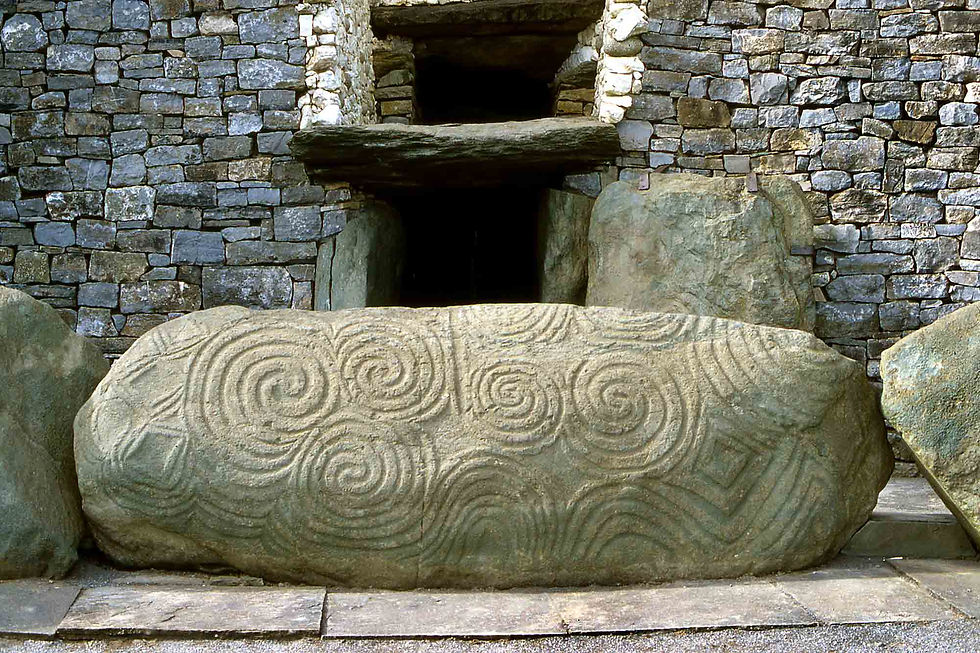
The curious can venture into the temple of Newgrange (Brú na Bóinne). This site is 1000 years older than the Pyramids of Giza. It was built by sky-worshipping people whose ingenuity still addles the minds of engineers today. This faithful testament was built upon the belief that every year, after the long, cold darkness of winter has been endured, the light shall return. And when it does, it shall be celebrated.
Those undaunted by Ireland’s narrow country roads will find themselves spellbound by the beauty of her undulating countryside. After a few days of winding through her curves, it’s not hard to imagine a subterranean kingdom within her large, round hills. Here, another race of people might reside.
The Daoine Sidhe
The Daoine Sidhe (DEE-na SHEE), or “people of the hills,” are said to be the descendants of the Tuatha de Danann (TOO-uh-huh dey DAH-nuh), the original inhabitants of Ireland. Centuries ago, the Tuatha de Danann lost a war with the Milesians, led by the great bard Amergin. He sailed to Ireland from Spain seeking revenge for his murdered kinsmen. Through artful cleverness, Amergin and his men prevailed. As the Tuatha de Danann agreed to do should Amergin be victorious, they retreated into the hills where they still live to this day. You may know them by other names, perhaps: fae, or fairy folk, “the good people,” or “the little people.”
Oh, come on! you say. That can’t be true!
Yet, such is Ireland’s ancient history, so deeply interwoven with myth and legend that “truth” is an elusive animal. It winks in and out of view like a fox on the heath, shrouded by an ever-shifting mist.
Tales of the Ancients
Some swear they’ve seen these ancient people roaming their forests and glens. Perhaps their grandmother used to put out offerings for them, to keep them from causing mischief. Maybe they were told as children to give hawthorn trees and stone circles a wide berth. The revenge for a disturbance of the Daoine Sidhe could result in anything from sleepless nights to death, depending on what sort you were dealing with.
Ireland’s loamy, endlessly re-tilled earth has been sown with seasons upon seasons of stories by countless generations of bards and troubadours. The golden harp upon her flag is a tribute to her ancient oral traditions. These traditions were valued so much that her people chose it as their national sigil. She holds long ribbons of lyrical traditions in her hands that stretch back to a time when man unfurled his history with his tongue rather than scribbling it down on the page.
This heritage remains. Her sons and daughters have never lost their talent for storytelling. Wherever you go, they’re willing to stop and chat, tell you a story, listen to yours, give you advice, and wish you well.
A Toast to Ireland
And so, in the spirit of what most tourists go to Ireland to do, I raise my glass to the mist-drenched land of Eire and her golden-tongued Celts—be they over or under the hills. May you continue to braid the truth into mystery forevermore!
Croagh Patrick

This is Croagh Patrick in County Mayo, said to be the holiest mountain in Ireland. Revered as a place of power by the druids, Patrick was warned not to scale its demon-haunted slopes. To prove the supreme power of his god, St. Patrick is said to have fasted forty days upon its rocky, wind-blown peak, inspiring a pilgrimage that endures to this day.
Oweynagat Cave

Into Oweynagat Cave on Autumn Equinox, 2019...
Underneath a hawthorn tree yawns the black mouth of a cave. Is it the Gates of Hell? Or a portal to the Otherworld? From the earliest references to Oweynagat Cave in the 9th century Cath Maige Mucrama (as recorded in the 12th century Book of Leinster), there is a clear association between Oweynagat and the Otherworld. The Irish Otherworld appears in the various stories as a sort of parallel dimension, inhabited by the Tuatha dé Danann (sometimes known as fairies or the sídhe) who fled there from our world after their defeat by the Milesians. The two worlds sometimes intersect through the actions of humans or the sídhe, and that interaction was viewed as more likely at particular places such as monuments or caves. Oweynagat Cave is also said to be the home of the Morrigan. She is portrayed as a goddess of battle and war, with the power to transform into crows or ravens. It is easy to see the connection between war and corvids (our battlefield scavengers). She features prominently in the Táin Bó Cuailgne (Cattle Raid of Cooley). First as a beautiful young woman who seeks to seduce the great warrior Cú Chulainn, and then after he rejected her, she sought to destroy him.
The Lia Fail, "Stone of Destiny"

The Lia Fáil, known as the Stone of Destiny, sits atop An Forradh (The King's Seat) at the Hill of Tara, Co. Meath, pictured here. The stone, according to legend, will cry out when the rightful king of Ireland puts his foot against it. According to the Lebor Gabála, the Book of Invasions, Lia Fáil was one of four mysterious objects brought to Ireland by the Tuatha Dé Danann.
Statue of Brian Boru

Statue of Brian Boru, throne and owls carved from an old tree on the grounds of Belvedere House, located approx 8 kms from Mullingar in County Westmeath on the north-east shore of Lough Ennell.
(Belvidere, Mullingar, Co. Westmeath, N91 EF80, Ireland)
Comments